
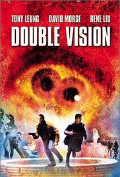
Directed by
Kuo-fu Chen
110 minutes
Rated R
Reviewed by
Ruth Williams

Double Vision
Synopsis: Taipei detective Huang Huo-tu (Tony Leung) doesn't go home any more. A decision he made to dob in a fellow officer for corrupt behaviour a couple of years earlier not only alienated him from his fellow officers, it also adversely affected his relationship with his family. As the foreign liaison officer, he doesn't have much to do other than wallow in his own guilt. This uneasy existence is soon interrupted when a serial killer doing the rounds of the city chooses an American as a victim. Kevin Richter (David Morse), an FBI agent specialising in serial killers is called in to provide assurance to the public that something is being done. A collision of cultures and beliefs soon erupts as the detectives are drawn deeper into a case strewn with clues that lead to possible supernatural ties.
Unlike the linear narrative style associated with films fresh out of the Hollywood studio system, the story in Double Vision seems to swirl out, much like the particles in the opening title sequence. Characters and events are introduced from all directions, almost as if they are being plucked out of the air. When an unusual black fungus is discovered at each crime scene, it appears as if the case is on its way to being solved, however other clues reveal a link with mystico-religious matters. This proves to be a satisfying thickening of the plot that pushes the characters towards their ultimate destiny.
The Jackie Chan and Chris Tucker partnership has become the staple diet when it comes to the way in which "Asian cop meets American cop" is usually portrayed by Hollywood. In Double Vision we see Richter's involvement through the eyes of the Taiwanese, and it is rather sobering. The officers' contempt for Richter is obvious, however Richter soon makes it clear that he has had to deal with tougher cases than this and will not be brushed off as an ignorant foreigner. It is in the more intimate moments shared between Richter and Huang that we are given some insight into how they perceive each other, and how they gradually come to accept their differences.
When it becomes apparent that there is a link between the murders and Taoist beliefs, the film-maker is faced with the challenge of including enough information to make sense to an audience unfamiliar with Taoism, without making it too didactic. The fact that everything has to be explained to Richter means that we are able to listen over his shoulder, thus discovering a world of symbols and prophecies, rich with meaning. Reminiscent of Seven, but not derivative, the revelation of the motive behind the murders initiates the viewer into this ancient philosophy and provides us with some understanding as to why the Taiwanese characters feel the need of talismans for protection.
.I can't say I understood everything I saw, however I do know I was touched by this film.

Want more about this film?


Want something different?


