
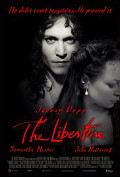
Directed by
Laurence Dunmore
114 minutes
Rated MA
Reviewed by
Bernard Hemingway

The Libertine
Synopsis: 17th-century English poet and notorious rake John Wilmot, second Earl of Rochester (Johnny Depp) was to be poet laureate to Charles II (John Malkovich). If only he could have depicted the troubled realm the way the monarch wished not the way he saw it – a cesspool of libidinal excess.
Muddy is a word of much relevance to Laurence Dunmore’s debut feature. The stuff abounds as a metaphoric image of the moral corruption that is the maker’s view of Restoration England. It sums up the umbrageous tonal range of the film that appears for the most part to be lit with a 25-watt globe. It describes the mood of what amounts to an account of the self-inflicted demise of a world-loathing man. And to some extent it describes the conceptual framework of the film.
Exactly what The Libertine is about, I am not sure. Far from being a gay costume romp or a foppish indulgence in sexual titillation it is a horrified picture of a world in decay, a kind of dark underbelly to Stage Beauty (2004). The settings, the interplay between court and theatre during the reign of Charles II, are similar but if the former was, at best, skilfully crafted entertainment this is a measured descent from dissolution to death. Not the most appealing of subjects you might think and you would be right.
Based on the play by Stephen Jeffreys, who also wrote the screenplay that delights in the mannered diction and play of wits that characterized the mode of the time, one cannot help feel the work has not entirely successfully been translated to the screen. It opens with a monologue by Wilmot telling us that he is “up for it” all the time and that we will not like him, not now and not by the end of what we are about to witness. Frankly neither claim is borne out. The problem here is with the casting of Depp, for how can anyone, male or female, NOT like him. Only a very good actor could overcome such good looks, and Depp who at least in the final stages of the film makes a very passable stab at it with the help of the make-up department, is simply not that good. John Malkovich who played Wilmot in its American stage incarnation I’m sure did it superbly but Depp remains essentially that little boy whose naughtiness will always be forgivable. And the sex? Well, as far as the film is concerned there is actually little of it.
In a work that is so clearly conceived for the stage the performances are all important and here the film does not allow its actors enough room to move, cluttering the screen with period detail and casting the proceedings largely in half-light. One scene stands out as an exception to this - the confrontation between the dying Wilmot and his long-suffering wife (Rosamund Pike). Here the camera takes us into a much closer relationship to the actors than would be possible in a theatre.
More fundamentally, given the lugubrious nature of the story it’s not clear what Dunmore and Jeffreys are trying to say here. There is no contrast between Wilmot’s happy home life and the loss of it at his horrible end; the horror is there to start with. There is no apparent moral to be drawn, no socio-political parallel evident between Restoration England and contemporary Anglo-American culture. There seemed to be some kind of significance in the final meeting between Wilmot and his protégé, the actress Elizabeth Barry (Samantha Morton), a kind of fatalistic irony in the dying Wilmot’s confession of love for a woman who does not care overmuch for him but it is too buried in the overall production to carry much weight.
The Libertine is a well-made film (edited by Australian veteran, Jill Bilcock) of consistently high quality, including an effective score by Michael Nyman, but one that suffers from an excess of obscurity.

Want more about this film?


Want something different?


